Imagen 1 de 1
Galería
Imagen 1 de 1

¿Quieres vender uno?
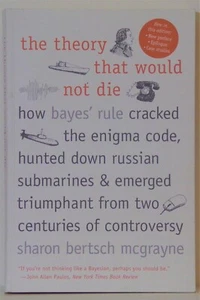
The Theory That Would Not Die : How Bayes' Rule Cracked the Enigma Code,
BEARS EMPORIUM
(4019)
Vendedor particular
USD8,95
Aproximadamente7,70 EUR
Estado:
“no marking in text - university tag on cover & inside front cover”
- ¡Cómpralo ya!The Theory That Would Not Die : How Bayes' Rule Cracked the Enigma Code,
Oops! Looks like we're having trouble connecting to our server.
Refresh your browser window to try again.
Envío:
USD6,47 (aprox. 5,57 EUR) USPS Media MailTM.
Ubicado en: Sterling, Colorado, Estados Unidos
Entrega:
Entrega prevista entre el sáb. 6 dic. y el mié. 10 dic. a 94104
Devoluciones:
30 días para devoluciones. El comprador paga el envío de la devolución..
Pagos:
Compra con confianza
Sobre este artículo
El vendedor asume toda la responsabilidad de este anuncio.
N.º de artículo de eBay:363508459027
Última actualización el 16 nov 2025 20:11:59 H.EspVer todas las actualizacionesVer todas las actualizaciones
Características del artículo
- Estado
- En muy buen estado
- Notas del vendedor
- “no marking in text - university tag on cover & inside front cover”
- Country of Origin
- United States
- Book Title
- The Theory That Would Not Die : How Bayes' Rule Cracked the Enigm
- Topic
- Mathematics
- Genre
- History
- Narrative Type
- Nonfiction
- Intended Audience
- Adults
- Educational Level
- College
- ISBN-13
- 9780300188226
- ISBN
- 9780300188226
Acerca de este producto
Product Identifiers
Publisher
Yale University Press
ISBN-10
0300188226
ISBN-13
9780300188226
eBay Product ID (ePID)
113090502
Product Key Features
Number of Pages
360 Pages
Language
English
Publication Name
Theory That Would Not Die : How Bayes' Rule Cracked the Enigma Code, Hunted down Russian Submarines, and Emerged Triumphant from Two Centuries of Controversy
Subject
History & Philosophy, History, Probability & Statistics / Bayesian Analysis
Publication Year
2012
Type
Textbook
Subject Area
Mathematics, Science
Format
Trade Paperback
Dimensions
Item Height
0.1 in
Item Weight
16 Oz
Item Length
0.9 in
Item Width
0.6 in
Additional Product Features
Intended Audience
Trade
TitleLeading
The
Dewey Edition
22
Reviews
"McGrayne''s The Theory That Would Not Die is the first popular science book to document the rocky story of Bayes''s rule . . . . Her tale has everything you would expect of a modern-day thriller. Espionage, nuclear warfare and cold war paranoia all feature as she tracks the theory''s crucial role in Alan Turing''s code-breaking during the second world war, and the US navy''s later use of the technique to track Soviet submarines."New Scientist, "Thorough research of the subject matter coupled with flowing prose, an impressive set of interviews with Bayesian statisticians, and an extremely engaging style in telling the personal stories of the few nonconformist heroes of the Bayesian school."-Sam Behseta, Chance, " The Theory That Would Not Die is an impressively researched, rollicking tale of the triumph of a powerful mathematical tool."-Andrew Robinson, Nature Vol. 475, "For the student who is being exposed to Bayesian statistics for the first time, McGrayne's book provides a wealth of illustrations to whet his or her appetite for more. It will broaden and deepen the field of reference of the more expert statistician, and the general reader will find an understandable, well-written, and fascinating account of a scientific field of great importance today."-Andrew I. Dale, Notices of the American Mathematical Society, "McGrayne holds the hand of the general reader as she lays out the history of the theorem and how it is now used in just about every walk of life… Science writing at its absolute peak."- The Bookseller, "A very engaging book that statisticians, probabilists, and history buffs in the mathematical sciences should enjoy."-David Agard, Cryptologaeia, "A masterfully researched tale of human struggle and accomplishment . . . . Renders perplexing mathematical debates digestible and vivid for even the most lay of audiences."-Michael Washburn, Boston Globe, "Delightful ... [and] McGrayne gives a superb synopsis of the fundamental development of probability and statistics by Laplace."-Scott L. Zeger of Johns Hopkins, Physics Today , "Well known in statistical circles, Bayes's Theorem was first given in a posthumous paper by the English clergyman Thomas Bayes in the mid-eighteenth century. McGrayne provides a fascinating account of the modern use of this result in matters as diverse as cryptography, assurance, the investigation of the connection between smoking and cancer, RAND, the identification of the author of certain papers in The Federalist, election forecasting and the search for a missing H-bomb. The general reader will enjoy her easy style and the way in which she has successfully illustrated the use of a result of prime importance in scientific work."- Andrew I. Dale, author of A History of Inverse Probability From Thomas Bayes to Karl Pearson and Most Honorable Remembrance: The Life and Work of Thomas Bayes, "[An] engrossing study….Her book is a compelling and entertaining fusion of history, theory and biography."-Ian Critchley, Sunday Times, " The Theory That Would Not Die is the first popular science book to document the rocky story of Bayes's rule. At times, her tale has everything you would expect of as modern-day thriller. . . . To have crafted a page-turner out of the history of statistics is an impressive feat. If only lectures at university had been this racy."-David Robson, New Scientist, "McGrayne is such a good writer that she makes this obscure battle gripping for the general reader."- Engineering and Technology Magazine, "Makes the theory come alive. . .enjoyable. . .densely packed and engaging, . . .very accessible. . .an admirable job of giving a voice to the scores of famous and non-famous people and data who contributed, for good or for worse."- Significance Magazine, "We now know how to think rationally about our uncertain world. This book describes in vivid prose, accessible to the lay person, the development of Bayes' rule over more than two hundred years from an idea to its widespread acceptance in practice." -Dennis Lindley, University College London, "This account of how a once reviled theory, Baye's rule, came to underpin modern life is both approachable and engrossing."- The Sunday Times, "Engaging....Readers will be amazed at the impact that Bayes'' rule has had in diverse fields, as well as by its rejection by too many statisticians....I was brought up, statistically speaking, as what is called a frequentist...But reading McGrayne''s book has made me determined to try, once again, to master the intricacies of Bayesian statisics. I am confident that other readers will feel the same."- The Lancet, "A very engaging book that statisticians, probabilists, and history buffs in the mathematical sciences should enjoy."-David Agard, CryptologIA, "To have crafted a page-turner out of the history of statistics is an impressive feat. If only lectures at university had been this racy."-New Scientist, "A lively, engaging historical account...McGrayne describes actuarial, business, and military uses of the Bayesian approach, including its application to settle the disputed authorship of 12 of the Federalist Papers, and its use to connect cigarette smoking and lung cancer...All of this is accomplished through compelling, fast-moving prose...The reader cannot help but enjoy learning about some of the more gossipy episodes and outsized personalities."- Choice, "A very compelling documented account. . .very interesting reading."-Jose Bernardo, Valencia List Blog, "We now know how to think rationally about our uncertain world. This book describes in vivid prose, accessible to the lay person, the development of Bayes' rule over more than two hundred years from an idea to its widespread acceptance in practice." --Dennis Lindley, University College London "A book simply highlighting the astonishing 200 year controversy over Bayesian analysis would have been highly welcome. This book does somuch more, however, uncovering the almost secret role of Bayesian analysis in a stunning series of the most important developments of the twentieth century. What a revelation and what a delightful read!"--James Berger, Arts & Sciences Professor of Statistics, Duke University, and member, National Academy of Sciences "Well known in statistical circles, Bayes's Theorem was first given in a posthumous paper by the English clergyman Thomas Bayes in the mid-eighteenth century. McGrayne provides a fascinating account of the modern use of this result in matters as diverse as cryptography, assurance, the investigation of the connection between smoking and cancer,RAND, the identification of the author of certain papers in The Federalist, election forecasting and the search for a missing H-bomb. The general reader will enjoy her easy style and the way in which she has successfully illustrated the use of a result of prime importance in scientific work."-- Andrew I. Dale, author of A History of Inverse Probability From Thomas Bayes to Karl Pearson and Most Honorable Remembrance: The Life and Work of Thomas Bayes "Compelling, fast-paced reading full of lively characters and anecdotes. . . .A great story." --Robert E. Kass,Carnegie Mellon University "Fascinating....I truly admire [McGrayne's] style of writing, and ... ability to turn complex mathematical ideas into intriguing stories, centered around real people."--Judea Pearl, winner of the 2012 Turing Award, "Fascinating….I truly admire [McGrayne's] style of writing, and … ability to turn complex mathematical ideas into intriguing stories, centered around real people."-Judea Pearl, winner of the 2012 Turing Award, "A book simply highlighting the astonishing 200 year controversy over Bayesian analysis would have been highly welcome. This book does so much more, however, uncovering the almost secret role of Bayesian analysis in a stunning series of the most important developments of the twentieth century. What a revelation and what a delightful read!"-James Berger, Arts & Sciences Professor of Statistics, Duke University, and member, National Academy of Sciences, " The Theory That Would Not Die is a rollicking tale of the triumph of a powerful mathematical tool."-Andrew Robinson, Nature, "An intellectual romp touching on, among other topics, military ingenuity, the origins of modern epidemiology, and the theological foundation of modern mathematics."-Michael Washburn, Boston Globe, "…..scientists and statisticians have fought over a deep philosophical divide about probability, which Sharon Bertsch McGrayne explores with great clarity and wit."-Christine Evans-Pughe, Engineering and Technology Magazine, "If you''re not thinking like a Bayesian, perhaps you should be."-John Allen Paulos, New York Times Book Review, " The Theory That Would Not Die is the first popular science book to document the rocky story of Bayes's rule. At times, her tale has everything you would expect of a modern-day thriller. . . . To have crafted a page-turner out of the history of statistics is an impressive feat. If only lectures at university had been this racy."-David Robson, New Scientist, "Compelling, fast-paced reading full of lively characters and anecdotes. . . .A great story." -Robert E. Kass, Carnegie Mellon University
Illustrated
Yes
Dewey Decimal
519.5/42
Synopsis
A New York Times Book Review Editor's Choice: A vivid account of the generations-long dispute over Bayes' rule, one of the greatest breakthroughs in the history of applied mathematics and statistics "An intellectual romp touching on, among other topics, military ingenuity, the origins of modern epidemiology, and the theological foundation of modern mathematics."--Michael Washburn, Boston Globe "To have crafted a page-turner out of the history of statistics is an impressive feat. If only lectures at university had been this racy."--David Robson, New Scientist Bayes' rule appears to be a straightforward, one-line theorem: by updating our initial beliefs with objective new information, we get a new and improved belief. To its adherents, it is an elegant statement about learning from experience. To its opponents, it is subjectivity run amok. In the first-ever account of Bayes' rule for general readers, Sharon Bertsch McGrayne explores this controversial theorem and the human obsessions surrounding it. She traces its discovery by an amateur mathematician in the 1740s through its development into roughly its modern form by French scientist Pierre Simon Laplace. She reveals why respected statisticians rendered it professionally taboo for 150 years--at the same time that practitioners relied on it to solve crises involving great uncertainty and scanty information (Alan Turing's role in breaking Germany's Enigma code during World War II), and explains how the advent of off-the-shelf computer technology in the 1980s proved to be a game-changer. Today, Bayes' rule is used everywhere from DNA de-coding to Homeland Security. Drawing on primary source material and interviews with statisticians and other scientists, The Theory That Would Not Die is the riveting account of how a seemingly simple theorem ignited one of the greatest controversies of all time., A vivid account of the generations-long dispute over one of the greatest breakthroughs in the history of applied mathematics and statistics Bayes' rule appears to be a straightforward, one-line theorem: by updating our initial beliefs with objective new information, we get a new and improved belief. To its adherents, it is an elegant statement about learning from experience. To its opponents, it is subjectivity run amok. In the first-ever account of Bayes' rule for general readers, Sharon Bertsch McGrayne explores this controversial theorem and the human obsessions surrounding it. She traces its discovery by an amateur mathematician in the 1740s through its development into roughly its modern form by French scientist Pierre Simon Laplace. She reveals why respected statisticians rendered it professionally taboo for 150 years--at the same time that practitioners relied on it to solve crises involving great uncertainty and scanty information (Alan Turing's role in breaking Germany's Enigma code during World War II), and explains how the advent of off-the-shelf computer technology in the 1980s proved to be a game-changer. Today, Bayes' rule is used everywhere from DNA de-coding to Homeland Security. Drawing on primary source material and interviews with statisticians and other scientists, The Theory That Would Not Die is the riveting account of how a seemingly simple theorem ignited one of the greatest controversies of all time.
LC Classification Number
QA279.5.M415 2011
Descripción del artículo del vendedor
Acerca de este vendedor
BEARS EMPORIUM
100% de votos positivos•8,2 mil artículos vendidos
Registrado como vendedor particularPor tanto, no se aplican los derechos de los consumidores derivados de las leyes de protección de los consumidores de la UE. La Garantía al cliente de eBay sigue aplicando a la mayoría de compras. Más informaciónMás información
Categorías populares de esta tienda
Votos de vendedor (4.081)
- -***8 (78)- Votos emitidos por el comprador.Último añoCompra verificadaGorgeous overall appearance, gently used condition, great value, and outstanding quality. Came swiftly, carefully packaged, and exactly as listed. Highly recommend this seller!Understandable Statistics : Concepts and Methods - Brase and Brase (#154314249399)
- h***- (1858)- Votos emitidos por el comprador.Últimos 6 mesesCompra verificadaTremendous value fot a used book of this quality. This seller has quick shipping which is a bonus. This seller is highly recommendedLOST CHRISTIANITIES: THE BATTLES FOR SCRIPTURE & THE FAITHS WE NEVER KNEW - BART (#152243111197)
- l***. (1847)- Votos emitidos por el comprador.Últimos 6 mesesCompra verificadaAs described. Carefully packed.