Imagen 1 de 2

Galería
Imagen 1 de 2


¿Quieres vender uno?
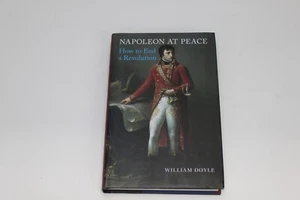
Napoleon at Peace: How to End a Revolution by William Doyle Hardback Book
thegoodstuff&electronics
(1939)
Vendedor particular
USD12,50
Aproximadamente10,74 EUR
o Mejor oferta
Estado:
“in good condition see photos for condition”
- ¡Cómpralo ya!Napoleon at Peace: How to End a Revolution by William Doyle Hardback Book
Oops! Looks like we're having trouble connecting to our server.
Refresh your browser window to try again.
Envío:
USD5,22 (aprox. 4,48 EUR) USPS Media MailTM.
Ubicado en: South Amboy, New Jersey, Estados Unidos
Entrega:
Entrega prevista entre el mar. 9 dic. y el lun. 15 dic. a 94104
Devoluciones:
30 días para devoluciones. El comprador paga el envío de la devolución..
Pagos:
Compra con confianza
Sobre este artículo
El vendedor asume toda la responsabilidad de este anuncio.
N.º de artículo de eBay:187430856934
Características del artículo
- Estado
- En buen estado
- Notas del vendedor
- “in good condition see photos for condition”
- Artist
- William Doyle
- Brand
- N/A
- Type
- Hardback
- EAN
- 9781789146172
- ISBN
- 1789146178
- Publication Name
- N/A
- Release Title
- Napoleon at Peace: How to End a Revolution
- Colour
- N/A
Acerca de este producto
Product Identifiers
Publisher
Reaktion Books, The Limited
ISBN-10
1789146178
ISBN-13
9781789146172
eBay Product ID (ePID)
27057269073
Product Key Features
Book Title
Napoleon at Peace : How to End a Revolution
Number of Pages
248 Pages
Language
English
Topic
Europe / France, Revolutionary
Publication Year
2022
Illustrator
Yes
Genre
History
Format
Hardcover
Dimensions
Item Height
1 in
Item Weight
15.1 Oz
Item Length
8.5 in
Item Width
5.5 in
Additional Product Features
Intended Audience
Trade
Dewey Edition
23
Reviews
Napoleon at peace may seem a contradiction in terms. Yet paradoxically, as William Doyle shows in this incisive and perfectly judged study, it was the brief period when he was not at war, the fourteen months between March 1802 and May 1803, that saw his most constructive achievement: restoring religious and civil peace to France after a traumatic decade of revolution., William Doyle's enlightening history immerses us in a crucial phase of Napoleon's career and France's past with originality and erudition., Napoleon at peace may seem a contradiction in terms. Yet paradoxically, as Doyle shows in this incisive and perfectly judged study, it was the brief period when he was not at war, the fourteen months between March 1802 and May 1803, that saw his most constructive achievement: restoring religious and civil peace to France after a traumatic decade of revolution., Doyle argues incisively that Napoleon's primary aim during the Consulate was political rather than military, as he sought to reverse what he saw as the errors of the Republic--to restore executive authority, curb disorder and insurgency, and resolve the religious schism that was the legacy of the previous decade. This book goes far to explain what Napoleon meant when he talked of his commitment to 'end the revolution'., Doyle, the distinguished historian of the Old Regime and the French Revolution . . . has turned his attention to Napoleon Bonaparte in this short, readable book. Largely a work of synthesis, the study nonetheless provides a fresh perspective on a man (and a regime) about whom one could reasonably argue we already know pretty much everything. In focusing on the narrow window of time between 1799 and 1802, and avoiding reference to what came later, we gain an understanding of these years that differs significantly from standard accounts, which tend to keep an eye on what Napoleon is most known for: his military prowess. Instead, the book focuses on Bonaparte's efforts to address head-on the divisive issues that had proven impossible to resolve over the course of the previous decade., Napoleon at Peace has interesting and important things to say. . . . Written with the sort of élan that would inspire envy in a squadron of cavalry, Doyle's book provides a scholarly and succinct account of General Bonaparte's unmaking of the French Revolution and his own remaking as an absolute prince., Doyle's enlightening history immerses us in a crucial phase of Napoleon's career and France's past with originality and erudition., Americans have long had a love-hate relationship with Napoleon Bonaparte. . . . There is Napoleon the genius general, whose swift and daring actions enabled him to conquer an entire continent. But there is also the Napoleon who spilled the blood of his men en masse and recklessly challenged all the nations of Europe, only to meet his final defeat at Waterloo. In his recent work, Napoleon at Peace , Bristol University historian William Doyle, a scholar well known for his revisionist histories of France, presents a unique and revolutionary version of Napoleon Bonaparte: that of Napoleon as peacemaker., William Doyle argues incisively that Napoleon's primary aim during the Consulate was political rather than military, as he sought to reverse what he saw as the errors of the Republic--to restore executive authority, curb disorder and insurgency, and resolve the religious schism that was the legacy of the previous decade. This book goes far to explain what Napoleon meant when he talked of his commitment to 'end the revolution'., To be sure, the French Revolution made Napoleon: officer commissions were no longer limited to nobility; the Corsican cultivated his celebrity with new forms of battle-focused propaganda; and, with great foresight, he appealed to le peuple , the emergent and dominating authority in politics. Many posit Napoleon's coup d'état of 18 Brumaire (November 9, 1799) to be the end of the French Revolution, but, as Doyle argues in Napoleon at Peace , the 'popular genera'--to borrow a term from Burke--spent three more years ending the Revolution's wars on European kingdoms, on religion, and on monarchic authority, ultimately gaining one year of true peace before war broke out again in 1803.
Dewey Decimal
944.05092
Synopsis
The French Revolution facilitated the rise of Napoleon Bonaparte, but after gaining power he knew that his first task was to end it. In this book William Doyle describes how he did so, beginning with the three large issues that had destabilized revolutionary France: war, religion and monarchy. Doyle shows how, as First Consul of the Republic, Napoleon resolved these issues: first by winning the war, then by forging peace with the Church and finally by making himself a monarch. Napoleon at Peace ends by discussing Napoleon's one great failure - his attempt to restore the colonial empire destroyed by war and slave rebellion. By the time this was abandoned, the fragile peace with Britain had broken down, and the Napoleonic wars had begun., A cogent, comprehensive, and sweeping account of Napoleon's dismantling of the French Revolution, giving new insight into this critical period of French history. The French Revolution facilitated the rise of Napoleon Bonaparte, but after gaining power he knew that his first task was to end it. In this book William Doyle describes how he did so, beginning with the three large issues that had destabilized revolutionary France: war, religion, and monarchy. Doyle shows how, as First Consul of the Republic, Napoleon resolved these issues: first by winning the war, then by forging peace with the Church, and finally by making himself a monarch. Napoleon at Peace ends by discussing Napoleon's one great failure--his attempt to restore the colonial empire destroyed by war and slave rebellion. By the time this endeavor was abandoned, the fragile peace with Great Britain had broken down, and the Napoleonic wars had begun.
LC Classification Number
DC202
Descripción del artículo del vendedor
Acerca de este vendedor
thegoodstuff&electronics
99,8% de votos positivos•5,2 mil artículos vendidos
Registrado como vendedor particularPor tanto, no se aplican los derechos de los consumidores derivados de las leyes de protección de los consumidores de la UE. La Garantía al cliente de eBay sigue aplicando a la mayoría de compras. Más informaciónMás información
Votos de vendedor (1.920)
- u***4 (495)- Votos emitidos por el comprador.Últimos 6 mesesCompra verificadaThis is a very nice copy, clean and well cared for, better than the listing described. Packaging was great to protect the book and it arrived safe and quicker than expected. Price was also a good value compared to other sellers. Very pleased with this transaction and thrilled to add this to my ocean liner book collection.
- i***3 (34)- Votos emitidos por el comprador.Últimos 6 mesesCompra verificadaThis is an outstanding seller very smooth transaction five stars plus *****+ all the way. Would definitely buy from this seller again. The DVD was not only as described, but like new. It was not only shipped promptly but very well packed for shipment.
- 8***f (62)- Votos emitidos por el comprador.Mes pasadoCompra verificadaGreat purchase! Good packaging, shipping, value and as described for the money. Will definitely purchase from this Seller again!
Más que explorar:
- Libros de literatura y narrativa William Shakespeare,
- Libros antiguos y de colección William Shakespeare,
- Libros infantiles y juveniles William Shakespeare,
- Libros antiguos y de colección Arthur Conan Doyle,
- Libros de literatura y narrativa Arthur Conan Doyle,
- Libros antiguos y de colección William Makepeace Thackeray