Imagen 1 de 3


Galería
Imagen 1 de 3


¿Quieres vender uno?
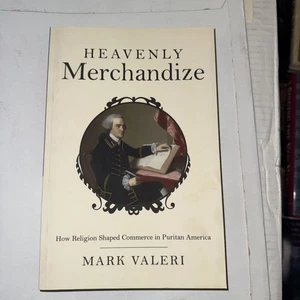
Heavenly Merchandize : How Religion Shaped Commerce in Puritan America by...
Scriptorium Books and Collectables
(5528)
Vendedor particular
USD34,99
Aproximadamente30,14 EUR
Estado:
- ¡Cómpralo ya!Heavenly Merchandize : How Religion Shaped Commerce in Puritan America by...
Oops! Looks like we're having trouble connecting to our server.
Refresh your browser window to try again.
Envío:
USD6,72 (aprox. 5,79 EUR) USPS Media MailTM.
Ubicado en: Pisgah Forest, North Carolina, Estados Unidos
Entrega:
Entrega prevista entre el vie. 5 dic. y el mié. 10 dic. a 94104
Devoluciones:
No se aceptan devoluciones.
Pagos:
Compra con confianza
Sobre este artículo
El vendedor asume toda la responsabilidad de este anuncio.
N.º de artículo de eBay:267428265233
Características del artículo
- Estado
- ISBN
- 9780691162171
Acerca de este producto
Product Identifiers
Publisher
Princeton University Press
ISBN-10
0691162174
ISBN-13
9780691162171
eBay Product ID (ePID)
177725544
Product Key Features
Number of Pages
360 Pages
Language
English
Publication Name
Heavenly Merchandize : How Religion Shaped Commerce in Puritan America
Subject
Economic History, Christianity / History, General, History, Sociology of Religion
Publication Year
2014
Type
Textbook
Subject Area
Religion, Social Science, Business & Economics
Format
Trade Paperback
Dimensions
Item Height
0.9 in
Item Weight
19 Oz
Item Length
9.2 in
Item Width
6.3 in
Additional Product Features
Intended Audience
College Audience
Dewey Edition
22
Reviews
"I found this book to be an outstanding contribution to our understanding of the working out of the Protestant ethic in colonial New England. Therefore, it is a major contribution to our understanding of American economic morality."-- Donald E. Frey, EH.Net, "An important and powerfully argued narrative. This work is large in scope and ambition. It assesses more than a century of change in the complex relationship between religious beliefs, practices, and disciplinary standards and the evolution of commercial and market behavior in colonial New England. Valeri takes his subject head-on and in full, knowing the pitfalls and the controversies that lie along the path." --Mark Peterson, University of California, Berkeley, "Valeri's reading of theological sources is so satisfying because he is a subtle, careful reader; he resists the temptation to smooth away contradictions, or to oversimplify; indeed, he seems allergic to polemic it is thus not surprising when, at the end of the book--just when the author might be expected to tip his hand about what all this market accommodation means--Valeri is maddeningly even-handed."-- Lauren F. Winner, Books & Culture, [T]he effectiveness with which Valeri utilizes the small-scale cultural world of Puritan Massachusetts in the colonial era in order to examine developments that have wider ramifications, indicates that, as with Perry Miller and so many others, that time and place is still a fruitful laboratory for thick analysis of religiocultural change. ---Dewey D. Wallace, Jr., Interpretation, "Valeri's reading of theological sources is so satisfying because he is a subtle, careful reader; he resists the temptation to smooth away contradictions, or to oversimplify; indeed, he seems allergic to polemic it is thus not surprising when, at the end of the book--just when the author might be expected to tip his hand about what all this market accommodation means--Valeri is maddeningly even-handed." ---Lauren F. Winner, Books & Culture, "[T]he effectiveness with which Valeri utilizes the small-scale cultural world of Puritan Massachusetts in the colonial era in order to examine developments that have wider ramifications, indicates that, as with Perry Miller and so many others, that time and place is still a fruitful laboratory for thick analysis of religiocultural change."-- Dewey D. Wallace, Jr., Interpretation, An important study. . . . [T]his stellar work breaks important new ground on the complex drama of economics and religion in early modern America. ---Robert E. Brown, Religious Studies Review, "An important study. . . . [T]his stellar work breaks important new ground on the complex drama of economics and religion in early modern America." ---Robert E. Brown, Religious Studies Review, "This book will certainly change the way both Puritan theology and economics are viewed and is highly recommended." ---Suzanne Geissler, Anglican and Episcopal History, "Valeri's well-written case studies bring many rewards to the reader. They forcefully demonstrate that no one can understand the changing culture of early America without paying attention to religion." ---R. Laurence Moore, Journal of Church History, "This book will certainly change the way both Puritan theology and economics are viewed and is highly recommended." --Suzanne Geissler, Anglican and Episcopal History, "[T]he effectiveness with which Valeri utilizes the small-scale cultural world of Puritan Massachusetts in the colonial era in order to examine developments that have wider ramifications, indicates that, as with Perry Miller and so many others, that time and place is still a fruitful laboratory for thick analysis of religiocultural change." ---Dewey D. Wallace, Jr., Interpretation, "The book is noteworthy as much for its method as for its conclusions. Valeri's inferences rise convincingly from his methodology, analysis, and rhetoric. . . . [H]andled artfully in an elegant narrative." --Barry Levy, American Historical Review, This book will certainly change the way both Puritan theology and economics are viewed and is highly recommended. ---Suzanne Geissler, Anglican and Episcopal History, "An important study. . . . [T]his stellar work breaks important new ground on the complex drama of economics and religion in early modern America." --Robert E. Brown, Religious Studies Review, "Students of early New England will find this indispensable; it should also appeal to anyone interested in the relationship between religion and the larger culture." -- Choice, Valeri's well-written case studies bring many rewards to the reader. They forcefully demonstrate that no one can understand the changing culture of early America without paying attention to religion. ---R. Laurence Moore, Journal of Church History, "[T]he effectiveness with which Valeri utilizes the small-scale cultural world of Puritan Massachusetts in the colonial era in order to examine developments that have wider ramifications, indicates that, as with Perry Miller and so many others, that time and place is still a fruitful laboratory for thick analysis of religiocultural change." --Dewey D. Wallace, Jr., Interpretation, " Heavenly Merchandize is a compelling original exploration of moral conviction and commercial culture in early New England. Boldly challenging the view that the demise of piety was a condition for the rise of opportunistic market behavior, Valeri finds that New England's ministers and merchants were neither traditionalists eclipsed by a secularizing Atlantic world nor easy protocapitalists rushing into modernity. He discloses a commercial community that was intent upon righteous trading and pious living." --Cathy Matson, University of Delaware, "I found this book to be an outstanding contribution to our understanding of the working out of the Protestant ethic in colonial New England. Therefore, it is a major contribution to our understanding of American economic morality." ---Donald E. Frey, EH.Net, "Valeri's reading of theological sources is so satisfying because he is a subtle, careful reader; he resists the temptation to smooth away contradictions, or to oversimplify; indeed, he seems allergic to polemic it is thus not surprising when, at the end of the book--just when the author might be expected to tip his hand about what all this market accommodation means--Valeri is maddeningly even-handed." --Lauren F. Winner, Books & Culture, "The book is noteworthy as much for its method as for its conclusions. Valeri's inferences rise convincingly from his methodology, analysis, and rhetoric. . . . [H]andled artfully in an elegant narrative."-- Barry Levy, American Historical Review, "This book will certainly change the way both Puritan theology and economics are viewed and is highly recommended."-- Suzanne Geissler, Anglican and Episcopal History, Students of early New England will find this indispensable; it should also appeal to anyone interested in the relationship between religion and the larger culture., "The book is noteworthy as much for its method as for its conclusions. Valeri's inferences rise convincingly from his methodology, analysis, and rhetoric. . . . [H]andled artfully in an elegant narrative." ---Barry Levy, American Historical Review, "Students of early New England will find this indispensable; it should also appeal to anyone interested in the relationship between religion and the larger culture."-- Choice, "Valeri's well-written case studies bring many rewards to the reader. They forcefully demonstrate that no one can understand the changing culture of early America without paying attention to religion." --R. Laurence Moore, Journal of Church History, Shortlisted for the 2011 American Academy of Religion Award for Excellence in the Historical Study of Religion, "I found this book to be an outstanding contribution to our understanding of the working out of the Protestant ethic in colonial New England. Therefore, it is a major contribution to our understanding of American economic morality." --Donald E. Frey, EH.Net, Winner of the 2011 Philip Schaff Prize, American Society of Church History Shortlisted for the 2011 American Academy of Religion Award for Excellence in the Historical Study of Religion One of Choice 's Outstanding Academic Titles for 2010, " Heavenly Merchandize treats the interconnected transformations of theology and the market in New England from earliest settlement in the 1620s to the mid-eighteenth century. The brilliance of Valeri's presentation is that he grounds it in the biographies and extensive testimonies of Boston merchants. In thoroughness, depth, scope, and significance, I rank this among a very elite group of truly seminal books." --Mark A. Noll, University of Notre Dame, The book is noteworthy as much for its method as for its conclusions. Valeri's inferences rise convincingly from his methodology, analysis, and rhetoric. . . . [H]andled artfully in an elegant narrative. ---Barry Levy, American Historical Review, Valeri's reading of theological sources is so satisfying because he is a subtle, careful reader; he resists the temptation to smooth away contradictions, or to oversimplify; indeed, he seems allergic to polemic it is thus not surprising when, at the end of the book--just when the author might be expected to tip his hand about what all this market accommodation means--Valeri is maddeningly even-handed. ---Lauren F. Winner, Books & Culture, " Heavenly Merchandize is a magisterial account of the interplay of economics and religion in early America. In place of abstract theories of 'modernization' or 'the spirit of capitalism,' Valeri engages representative figures on the ground, and through their stories narrates the ways in which transformations in religious thought actually shaped a premodern market culture. Students of early American religion, economics, and imperialism will have to consult this seminal work." --Harry S. Stout, Yale University, "Valeri's well-written case studies bring many rewards to the reader. They forcefully demonstrate that no one can understand the changing culture of early America without paying attention to religion."-- R. Laurence Moore, Journal of Church History, I found this book to be an outstanding contribution to our understanding of the working out of the Protestant ethic in colonial New England. Therefore, it is a major contribution to our understanding of American economic morality. ---Donald E. Frey, EH.Net
Illustrated
Yes
Dewey Decimal
261.8/5097409032
Synopsis
Heavenly Merchandize offers a critical reexamination of religion's role in the creation of a market economy in early America. Focusing on the economic culture of New England, it views commerce through the eyes of four generations of Boston merchants, drawing upon their personal letters, diaries, business records, and sermon notes to reveal how merchants built a modern form of exchange out of profound transitions in the puritan understanding of discipline, providence, and the meaning of New England. Mark Valeri traces the careers of men like Robert Keayne, a London immigrant punished by his church for aggressive business practices; John Hull, a silversmith-turned-trader who helped to establish commercial networks in the West Indies; and Hugh Hall, one of New England's first slave traders. He explores how Boston ministers reconstituted their moral languages over the course of a century, from a scriptural discourse against many market practices to a providential worldview that justified England's commercial hegemony and legitimated the market as a divine construct.Valeri moves beyond simplistic readings that reduce commercial activity to secular mind-sets, and refutes the popular notion of an inherent affinity between puritanism and capitalism. He shows how changing ideas about what it meant to be pious and puritan informed the business practices of Boston's merchants, who filled their private notebooks with meditations on scripture and the natural order, founded and led churches, and inscribed spiritual reflections in their letters and diaries. Unprecedented in scope and rich with insights, Heavenly Merchandize illuminates the history behind the continuing American dilemma over morality and the marketplace., Heavenly Merchandize offers a critical reexamination of religion's role in the creation of a market economy in early America. Focusing on the economic culture of New England, it views commerce through the eyes of four generations of Boston merchants, drawing upon their personal letters, diaries, business records, and sermon notes to reveal how merchants built a modern form of exchange out of profound transitions in the puritan understanding of discipline, providence, and the meaning of New England. Mark Valeri traces the careers of men like Robert Keayne, a London immigrant punished by his church for aggressive business practices; John Hull, a silversmith-turned-trader who helped to establish commercial networks in the West Indies; and Hugh Hall, one of New England's first slave traders. He explores how Boston ministers reconstituted their moral languages over the course of a century, from a scriptural discourse against many market practices to a providential worldview that justified England's commercial hegemony and legitimated the market as a divine construct. Valeri moves beyond simplistic readings that reduce commercial activity to secular mind-sets, and refutes the popular notion of an inherent affinity between puritanism and capitalism. He shows how changing ideas about what it meant to be pious and puritan informed the business practices of Boston's merchants, who filled their private notebooks with meditations on scripture and the natural order, founded and led churches, and inscribed spiritual reflections in their letters and diaries. Unprecedented in scope and rich with insights, Heavenly Merchandize illuminates the history behind the continuing American dilemma over morality and the marketplace., Heavenly Merchandize offers a critical reexamination of religion's role in the creation of a market economy in early America. Focusing on the economic culture of New England, it views commerce through the eyes of four generations of Boston merchants, drawing upon their personal letters, diaries, business records, and sermon notes to reveal how merc
Descripción del artículo del vendedor
Acerca de este vendedor
Scriptorium Books and Collectables
100% de votos positivos•4,6 mil artículos vendidos
Registrado como vendedor particularPor tanto, no se aplican los derechos de los consumidores derivados de las leyes de protección de los consumidores de la UE. La Garantía al cliente de eBay sigue aplicando a la mayoría de compras. Más informaciónMás información
Categorías populares de esta tienda
Votos de vendedor (2.419)
- o***r (1962)- Votos emitidos por el comprador.Últimos 6 mesesCompra verificadaExcellent transaction, great communication. Trustworthy, well packed and item arrive just as expected. Hope to do business again. Worked with me on a better shipping price. all good. Thanks.Vintage 1939 Gibson L-5 Guitar - Amazing Archtop - L5 Gibson (#267242604988)
- n***a (2)- Votos emitidos por el comprador.Últimos 6 mesesCompra verificadaPerfect sale, I had a question and scriptorium books and collectibles answered quickly and accurately. My package arrived in good condition. I would recommend this seller to anyone.Playmobil 5300 Victorian Dollhouse 5551 Piano PLAYS Tune Music Rare mansion (#384779109125)
- l***4 (477)- Votos emitidos por el comprador.Últimos 6 mesesCompra verificadaA+ seller. Fast and safe ship. Item as described. A pleasure!!Portmeirion Botanic Garden Cereal Oatmeal Bowl Forget Me Not England (#267251807976)
Más que explorar:
- Libros de texto de religión,
- Libros de literatura y narrativa, religión,
- Libros prácticos y de consulta religiones,
- Libros de texto de religión en inglés,
- Libros de texto de religión en español,
- Libros libro de texto de religión,
- Libros prácticos y de consulta, religión,
- Libros antiguos y de colección, sobre filosofía y religión,
- Libros prácticos y de consulta religiones en hebreo,
- Libros prácticos y de consulta, religión, en español